
Understanding Peptide Concentrations: mg, mcg & mL Explained
6 Aug 2026
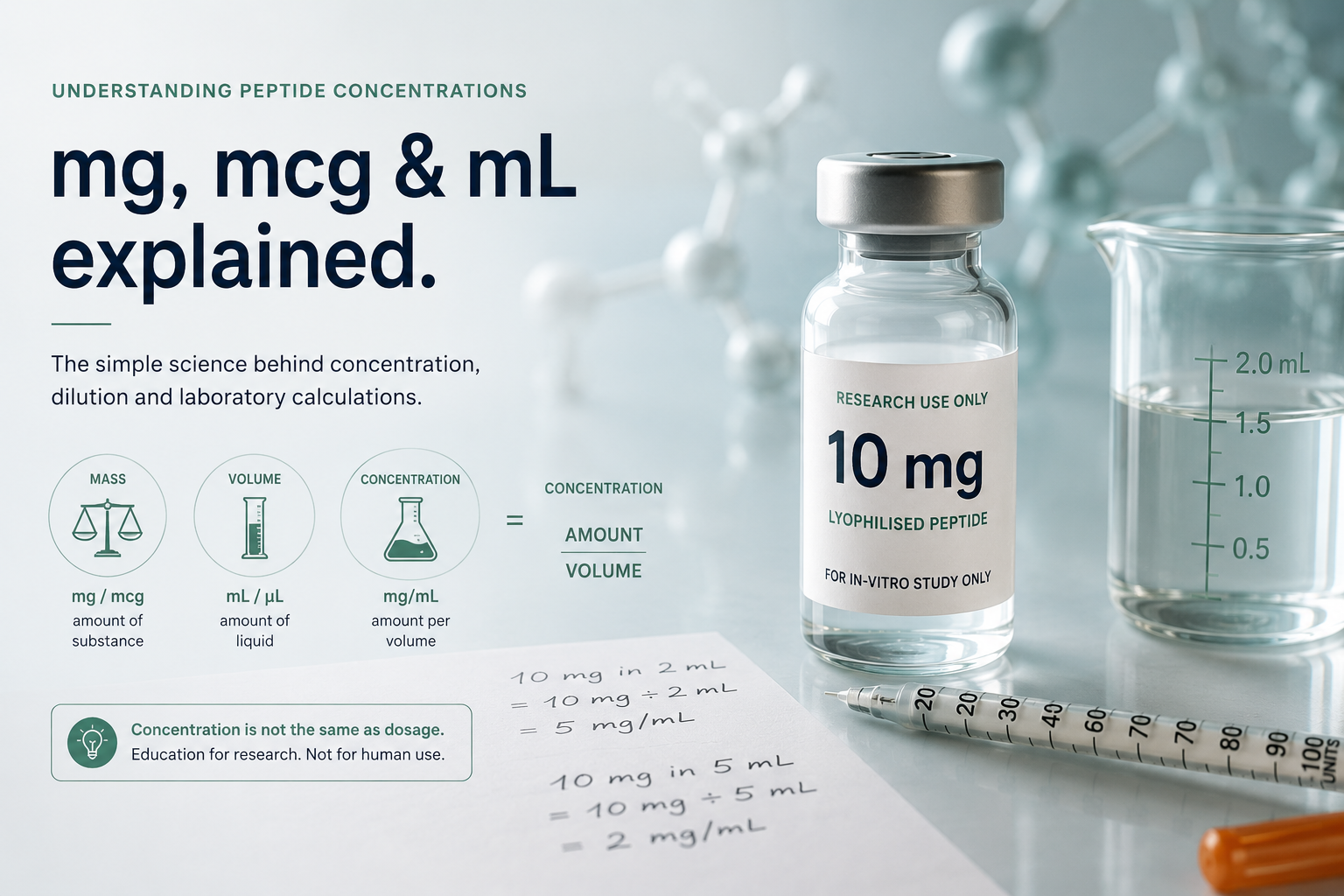
The simple science behind concentration, dilution and laboratory peptide calculations
If you've ever looked at a research peptide vial and wondered what 5 mg, 10 mg, mcg or mg/mL actually means, you're not alone.
These units describe different things, and confusing them can completely change the meaning of a calculation.
A vial labelled 10 mg tells us how much material is present.
It does not tell us its concentration.
It does not describe a dose.
And it does not tell us what volume should be used for any particular purpose.
To understand research peptide concentrations properly, we need to separate three concepts:
Amount. Volume. Concentration.
Once those are understood, the maths becomes surprisingly simple.
First: What Does “mg” Mean?
mg stands for milligram.
A milligram is a unit of mass.
There are:
1,000 micrograms (mcg) in 1 milligram (mg).
So:
1 mg = 1,000 mcg
5 mg = 5,000 mcg
10 mg = 10,000 mcg
This conversion doesn't change the amount of material present.
It's simply expressing the same quantity using a different unit.
Think about metres and centimetres.
One metre and 100 centimetres describe exactly the same length.
Likewise:
10 mg and 10,000 mcg describe exactly the same mass.
What Does the Number on a Research Vial Mean?
Imagine a laboratory vial containing:
10 mg of a lyophilised research compound.
That tells us the total mass of material in the vial.
Nothing more.
Lyophilised means the material has been freeze-dried, leaving a dry product that can improve stability during storage compared with the same compound already dissolved in liquid.
So before any solvent is introduced, we know the vial contains:
10 mg of material.
But we cannot yet express its concentration in mg/mL.
Why?
Because there is no liquid volume to relate that mass to.
Then We Introduce Volume
Liquid volume is commonly expressed in millilitres (mL).
There are:
1,000 microlitres (µL) in 1 millilitre (mL).
Once a known volume of an appropriate laboratory solvent is added to a known mass of material, we can calculate the resulting concentration.
And this is where the important distinction appears.
The amount of compound hasn't changed.
Its concentration has.
What Is Concentration?
Concentration describes how much substance is present within a given volume.
A common way of expressing this is:
mg/mL — milligrams per millilitre.
The basic laboratory relationship is:
Concentration = Amount ÷ Volume
For example, imagine a laboratory preparation containing:
10 mg of compound in a total volume of 2 mL.
The resulting concentration would be:
10 mg ÷ 2 mL = 5 mg/mL
This means every 1 mL of that laboratory solution contains 5 mg of compound.
If instead the same 10 mg were present in a total volume of 5 mL:
10 mg ÷ 5 mL = 2 mg/mL
The amount of compound hasn't changed.
Both preparations still contain 10 mg in total.
What changed was the volume — and therefore the concentration.
Amount and Concentration Are Not the Same Thing
This is probably the single most useful concept to understand.
Imagine two laboratory containers.
Sample A
Contains 10 mg in 1 mL.
Its concentration is:
10 mg/mL
Sample B
Contains 10 mg in 5 mL.
Its concentration is:
2 mg/mL
Both contain exactly the same total amount of compound:
10 mg.
But Sample A is five times more concentrated.
That's why simply knowing how many milligrams are in a vial doesn't tell you the concentration of a prepared solution.
You need to know the volume too.
What Does mcg Mean?
mcg is commonly used to represent micrograms.
The scientific symbol is µg, but “mcg” is frequently used in healthcare and other settings because the Greek letter µ can potentially be misread.
A microgram is one-thousandth of a milligram.
So:
1 mg = 1,000 mcg
and therefore:
1 mcg = 0.001 mg
This matters enormously when reading scientific literature because peptide quantities may be reported in either milligrams or micrograms.
A value of:
500 mcg
is therefore the same mass as:
0.5 mg.
It is not 500 mg.
That difference is a factor of 1,000.
Why Unit Conversion Matters in Research
Laboratory calculations often involve very small quantities.
A misplaced decimal point or confusion between mg and mcg can therefore produce an enormous error.
Consider:
1 mg
versus
1 mcg.
They look similar on the page.
But:
1 mg = 1,000 mcg.
The first represents one thousand times more material than the second.
This is why scientific calculations should always retain the units throughout the calculation rather than simply working with numbers.
The unit is part of the measurement.
Concentration Can Also Be Expressed in mcg/mL
Because:
1 mg = 1,000 mcg
a concentration expressed in mg/mL can also be converted into mcg/mL.
For example:
2 mg/mL
is equivalent to:
2,000 mcg/mL.
Again, nothing about the actual solution has changed.
We're simply expressing the concentration using a smaller unit.
This is often useful when reading experimental papers where researchers are working with very small quantities.
Dilution: Same Material, Different Concentration
Another fundamental laboratory concept is dilution.
Dilution means reducing the concentration of a solution by increasing its volume.
Imagine a research solution containing:
10 mg of compound in 2 mL.
Its concentration is:
5 mg/mL.
If sufficient solvent were then added to produce a total volume of 10 mL, assuming no compound was lost, the solution would still contain:
10 mg total compound.
But its new concentration would be:
1 mg/mL.
The material hasn't disappeared.
It has simply become distributed through a larger volume.
A Useful Way to Visualise It
Imagine putting one teaspoon of cordial into a small glass of water.
Now put the same teaspoon of cordial into a large jug of water.
The amount of cordial is identical.
But the drink in the small glass will be much more concentrated.
The principle is exactly the same.
Same amount. Different volume. Different concentration.
Concentration Is Not the Same as Dosage
This distinction is particularly important.
A concentration calculation answers a scientific question such as:
How much material is present per unit of volume?
A dosage calculation answers a completely different question:
How much of a substance should be administered?
Those are not interchangeable.
Concentration is a property of a laboratory solution.
Dosage involves decisions about biological administration and requires information about the substance, route, subject, safety, pharmacology and intended purpose.
Knowing that a research solution contains 5 mg/mL therefore tells us nothing about what quantity would be appropriate for administration to a person or animal.
For Better Body Lab research products, the distinction is especially important:
Understanding concentration is laboratory mathematics — it is not an instruction for use.
Why Doesn't Better Body Lab Provide Dosing Calculators?
You may encounter online calculators that combine vial strength and liquid volume with a proposed human dose and then calculate how much should be drawn into a syringe.
That's no longer simply a concentration calculation.
It is providing information that can facilitate administration.
Better Body Lab products labelled for research use only are supplied for laboratory research and are not intended for human or veterinary use.
For that reason, our educational material focuses on understanding the underlying science:
mass
units
volume
concentration
and
laboratory calculations.
We do not provide individual dosing protocols or instructions for human administration.
What About “Units” on a Syringe?
This is another common source of confusion.
A syringe marked in “units” is displaying a volume scale designed for that particular type of syringe.
It is not directly measuring milligrams or micrograms of a peptide.
The amount of a dissolved substance present in any particular liquid volume depends entirely on the concentration of that solution.
For this reason, “units” should never be treated as though they are automatically equivalent to a particular mass of compound.
They aren't.
And Better Body Lab does not provide syringe-based administration calculations for research products.
Why Lyophilised Products Are Used in Research
Many peptide research products are supplied in a lyophilised, or freeze-dried, state.
Lyophilisation removes water from a frozen material under carefully controlled conditions.
The technique is widely used in pharmaceutical and biochemical research because removing water can improve the stability of molecules that may otherwise degrade more rapidly in solution.
However, stability varies considerably between compounds.
Factors including:
temperature,
light,
pH,
solvent,
oxygen exposure,
and time after preparation
can all potentially influence stability.
Researchers therefore need to follow appropriate laboratory protocols and compound-specific stability information rather than assuming every lyophilised compound behaves identically.
Purity and Concentration Aren't the Same Thing Either
Here's another useful distinction.
Concentration tells us how much material is present within a particular volume.
Purity describes the composition of the material itself.
A laboratory product reported as having a particular analytical purity isn't therefore describing its concentration.
Likewise, increasing or decreasing the volume of a prepared solution changes its concentration but does not somehow increase the analytical purity of the original material.
They are separate measurements answering separate scientific questions.
Four Numbers — Four Different Meanings
When reading information about a laboratory research compound, you might encounter:
10 mg The mass of material.
2 mL The liquid volume.
5 mg/mL The resulting concentration.
99% purity An analytical measure relating to the composition of the tested material.
These numbers describe different properties.
Understanding which one you're looking at is essential before interpreting any scientific data.
Why This Matters When Reading Research Papers
Scientific papers rarely use one universal way of reporting peptide concentrations.
Depending on the experiment, researchers may report:
mg/mL
mcg/mL
µg/mL
ng/mL
or molar concentrations such as µM and nM.
Cell-culture studies in particular frequently use molar concentration rather than simply mass per volume because researchers may want to compare the actual number of molecules present.
That introduces molecular weight into the calculation — a subject worthy of an article of its own.
But the underlying principle remains the same:
scientific measurements only make sense when we understand both the number and its unit.
The Bigger Picture: Understand the Measurement
Peptide science can appear unnecessarily complicated because it involves unfamiliar terminology and very small measurements.
But the fundamentals are straightforward.
mg and mcg measure mass.
mL measures volume.
mg/mL or mcg/mL describe concentration.
And:
concentration = amount ÷ volume.
Understanding those relationships makes scientific literature easier to interpret and laboratory calculations easier to check.
More importantly, it helps separate two things that are frequently blurred together online:
understanding the chemistry of a research solution
and
giving instructions for biological administration.
They are not the same thing.
At Better Body Lab, our aim is to make the science easier to understand without pretending that education replaces appropriate laboratory procedures, clinical evidence or professional medical guidance.
Because good science doesn't begin with blindly following a number.
It begins with understanding what the number actually means.
Research. Understand. Explore.
Quick Reference
1 mg = 1,000 mcg
1 mL = 1,000 µL
Concentration (mg/mL) = mass (mg) ÷ total volume (mL)
10 mg in 2 mL = 5 mg/mL
10 mg in 5 mL = 2 mg/mL
The examples above demonstrate laboratory concentration mathematics only. They are not dosing or administration instructions.
Important Research Disclaimer
This article is provided for research and educational purposes only and explains general scientific concepts involving mass, volume, concentration, dilution and lyophilised laboratory materials.
Examples are included solely to demonstrate mathematical and laboratory principles. They should not be interpreted as dosing information, administration guidance, reconstitution instructions for human use or a recommendation to use any research compound.
Better Body Lab research products are not intended for human or veterinary consumption or administration.
Nothing in this article constitutes medical advice, diagnosis or treatment.
Better Body Lab | Research. Understand. Explore.