
The Power of Natural Signalling: Ipamorelin & the Growth Hormone Pathway
6 Jul 2026
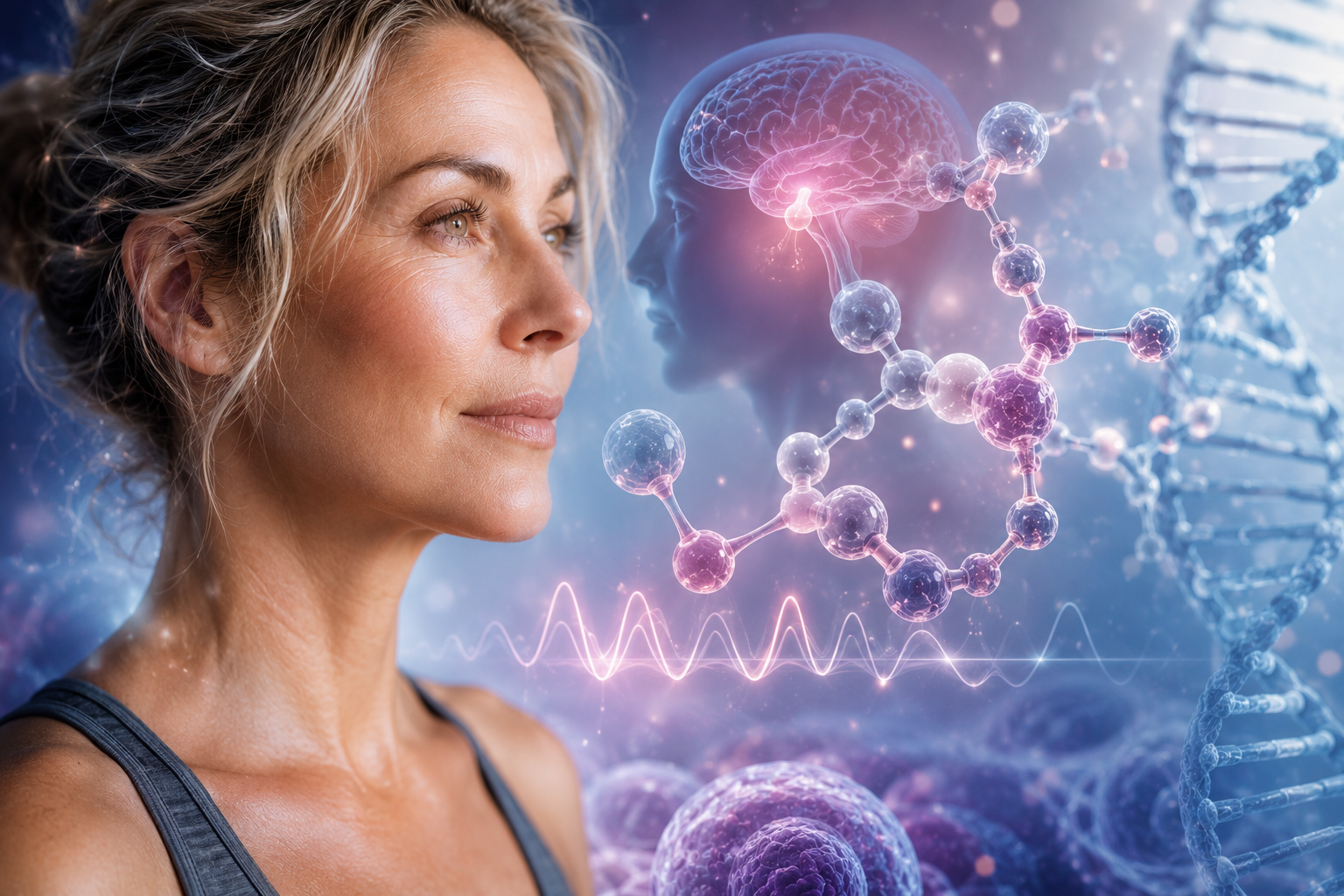
What happens when we signal the body to release a hormone rather than simply supplying the hormone itself?
Our hormones don't usually work like an on/off switch.
They rise and fall.
They respond to sleep, food, exercise, stress, age and signals from other hormones.
Some are released continuously. Others arrive in distinct pulses.
Growth hormone is a particularly good example.
Rather than circulating at a constant level throughout the day, growth hormone (GH) is normally secreted by the pituitary gland in bursts — with one of the largest pulses typically associated with slow-wave sleep.
As we age, the amplitude and frequency of these pulses tend to decline.
That has led researchers to investigate an interesting question:
Instead of simply supplying growth hormone from outside the body, can we stimulate the body's own signalling system to release it?
This is where growth hormone secretagogues enter the story.
And one of the most studied examples is a small peptide called Ipamorelin.
What Is Ipamorelin?
Ipamorelin is a synthetic pentapeptide — a molecule consisting of five amino-acid residues.
It belongs to a group of compounds known as growth hormone secretagogues.
The important word here is secretagogue.
A secretagogue doesn't supply growth hormone itself.
Instead, it interacts with receptors involved in the body's regulation of GH secretion, signalling the pituitary to release growth hormone.
Ipamorelin was originally identified during research attempting to develop a more selective growth hormone secretagogue.
Early pharmacological experiments found that it produced substantial GH release while having considerably less effect on other pituitary hormones than some earlier compounds.
And that's where the concept of natural signalling becomes interesting.
Replacing a Hormone vs Signalling Its Release
These are fundamentally different biological approaches.
Administering recombinant growth hormone introduces GH directly into the circulation.
A growth hormone secretagogue works further upstream.
It activates a receptor involved in the body's own GH regulatory system, prompting the pituitary to release stored growth hormone.
That distinction matters because normal endocrine physiology is highly dynamic.
Hormones don't merely need to be present.
Timing, concentration, feedback loops and patterns of secretion all matter.
And growth hormone is naturally highly pulsatile.
Does Ipamorelin Really Produce a GH Pulse?
This is one area where we actually have human evidence.
A 1999 pharmacokinetic and pharmacodynamic study administered different doses of Ipamorelin to healthy volunteers and measured both Ipamorelin and circulating growth hormone.
Researchers observed a distinct episode of GH release.
Growth hormone reached its peak approximately 0.67 hours after administration before declining towards negligible concentrations.
Ipamorelin produced GH release at every dose studied.
That's an important result because it demonstrates the fundamental mechanism in humans:
Signal → pituitary response → temporary GH release.
It does not, however, demonstrate that Ipamorelin improves sleep, builds muscle, reduces body fat or reverses ageing.
Those are separate clinical questions requiring separate evidence.
And that distinction is extremely important.
Why Was Ipamorelin Considered Different?
Ipamorelin wasn't the first growth hormone-releasing peptide.
Earlier compounds included GHRP-2 and GHRP-6.
One problem researchers encountered with some earlier growth hormone secretagogues was a lack of complete selectivity.
They could stimulate GH but could also affect other endocrine pathways.
When Ipamorelin was characterised experimentally, researchers found something interesting.
It demonstrated strong GH-releasing activity while having substantially less effect on ACTH and cortisol than GHRP-2 and GHRP-6 in the animal experiments used to characterise it.
The researchers consequently described Ipamorelin as the first selective growth hormone secretagogue.
That's one reason it remains scientifically interesting.
It isn't necessarily about generating the biggest possible hormonal response.
It's about investigating whether a more targeted signal can influence one pathway without unnecessarily activating others.
Why Is This Particularly Interesting as We Age?
Growth hormone secretion changes considerably across the lifespan.
GH secretion is high during growth and adolescence and progressively declines during adulthood.
This age-related decline in GH secretion is sometimes called the somatopause.
The downstream hormone IGF-1 — insulin-like growth factor 1 — also tends to decline with age.
In women, there is another layer to this story.
Estrogen and growth hormone interact.
Estrogens influence both GH secretion and the body's responsiveness to GH.
The hormonal transition around menopause therefore occurs alongside age-related changes in the GH/IGF-1 axis. A major review of menopause and GH physiology describes a physiological decline in GH secretion during ageing and following menopause.
This doesn't mean declining GH is a disease.
Nor does it mean restoring GH to youthful levels is necessarily desirable.
It means female ageing involves several interconnected endocrine systems changing simultaneously.
That's much more interesting than looking at any hormone in isolation.
GH, IGF-1 & Body Composition
One reason the GH pathway attracts so much attention is its role in metabolism.
Growth hormone participates in:
lipid metabolism protein metabolism glucose regulation maintenance of lean tissue energy utilisation.
GH also stimulates production of IGF-1, particularly in the liver, although GH and IGF-1 have distinct and sometimes overlapping effects throughout the body.
The age-associated decline in this axis occurs at roughly the same stage of life when many people notice changes in muscle mass and fat distribution.
But correlation isn't proof that declining GH alone causes those changes.
Ageing simultaneously alters sex hormones, physical activity, sleep, nutrition, insulin sensitivity and numerous other biological systems.
And importantly, research into GH and ageing has not established growth hormone restoration as a general rejuvenation strategy.
What About Skin & Collagen?
Here's another area where we need to separate pathway biology from Ipamorelin evidence.
There is good biological evidence connecting the GH/IGF-1 axis with skin.
Fibroblasts — the cells responsible for producing much of the extracellular matrix within skin — respond to GH and IGF-1 signalling.
Research has linked GH signalling with fibroblast proliferation and activity as well as synthesis of collagen types I and III.
So the GH/IGF-1 axis clearly participates in connective-tissue biology.
But that doesn't allow us to jump to:
Ipamorelin increases collagen and tightens ageing skin.
Human clinical evidence demonstrating that outcome is currently lacking.
The scientifically defensible conclusion is more modest:
Ipamorelin can stimulate GH release, and GH/IGF-1 signalling participates in connective-tissue physiology. Whether Ipamorelin produces meaningful clinical improvements in ageing human skin remains uncertain.
That's less sensational.
But it's better science.
Bone: Another Important Part of the GH/IGF-1 Story
Bone isn't static.
Throughout life, old bone is continuously broken down and replaced with new tissue through a process called bone remodelling.
GH and IGF-1 participate in this system and influence bone formation and osteoblast activity.
This becomes particularly relevant to female physiology because menopause introduces another major change:
declining estrogen accelerates bone loss.
It would therefore be overly simplistic to view GH signalling as the solution to menopausal bone health.
Estrogen status, resistance and impact exercise, calcium and vitamin D availability, genetics, body composition and numerous other factors contribute to skeletal health.
Again, physiology works as a network.
What About Sleep & Recovery?
This is probably where Ipamorelin is most commonly misunderstood online.
Growth hormone and sleep are closely connected.
A major natural GH pulse occurs around slow-wave sleep.
But this relationship doesn't automatically work backwards.
In other words:
GH is strongly associated with deep sleep physiology.
That does not prove that stimulating GH secretion with Ipamorelin improves sleep.
Claims such as improved sleep quality, better morning energy and enhanced exercise recovery are widely reported anecdotally.
They are not the same thing as controlled clinical evidence.
At present, we don't have robust human trials demonstrating that Ipamorelin reliably improves sleep quality or exercise recovery in healthy ageing women.
That's an important research gap.
Natural Doesn't Automatically Mean Better
There's another important nuance to the idea of “natural signalling.”
Stimulating endogenous hormone production can sound inherently safer or more physiological than administering a hormone directly.
But using the body's own pathway does not automatically make an intervention natural, safe or beneficial.
Ipamorelin itself is synthetic.
And altering an endocrine signalling pathway can have downstream consequences even when the final hormone is produced by the body.
This is particularly relevant to GH and IGF-1 because their relationship with ageing is surprisingly complicated.
The Longevity Paradox
If more growth hormone were simply better, we might expect higher lifelong GH and IGF-1 signalling to be associated with longer life.
The biology doesn't neatly support that assumption.
In several animal models, reduced GH/IGF-1 signalling is associated with increased lifespan.
That has created something of a longevity paradox.
GH and IGF-1 are important for maintaining muscle, bone, metabolism and tissue function.
Yet chronically increasing growth-related signalling may not necessarily promote longevity.
A major review in Nature Reviews Endocrinology highlights this complexity: although GH and IGF-1 decline with age, experimental models with reduced GH/IGF-1 signalling can demonstrate increased longevity.
This is a brilliant example of why ageing biology rarely gives us simple answers.
The goal isn't necessarily:
More GH = younger.
The real question may be:
What level and pattern of signalling supports healthy function at each stage of life?
The Bigger Picture for Women
Perimenopause and menopause aren't simply estrogen-deficiency events.
Multiple systems can change during midlife:
sex hormones,
sleep,
body composition,
insulin sensitivity,
bone remodelling,
muscle mass,
connective tissue,
and the GH/IGF-1 axis.
Trying to optimise one pathway while ignoring everything else therefore misses the bigger biological picture.
Resistance training provides a powerful physiological signal to muscle and bone.
Adequate protein provides the raw materials required for tissue maintenance.
Sleep supports normal endocrine rhythms.
Nutrition provides the micronutrients required for normal cellular processes.
And appropriate medical investigation can identify genuine endocrine or nutritional deficiencies rather than assuming every symptom represents an optimisation problem.
Peptides don't replace that biology.
At their most scientifically interesting, they help us understand it.
The Power of Signalling
Perhaps this is the bigger lesson from Ipamorelin research.
The human body is built around communication.
Hormones signal.
Receptors listen.
Cells respond.
Feedback mechanisms regulate the response.
Ipamorelin is interesting because rather than being growth hormone itself, it acts further upstream — sending a signal into an existing endocrine pathway and prompting the body to respond.
Human research confirms that this signal can generate a temporary growth hormone pulse.
What has not yet been established is whether repeatedly generating those pulses translates into meaningful improvements in body composition, sleep, skin, bone health, recovery or healthy ageing in women.
Those are exactly the questions good research still needs to answer.
And that's why understanding the mechanism matters.
The future of peptide science may not simply be about replacing what the body has lost.
It may increasingly be about understanding how the body communicates — and what happens when we influence those signals.
Research. Understand. Explore.
Research & Further Reading
The original pharmacological characterisation of Ipamorelin described it as a selective GH secretagogue and investigated its effects relative to earlier GHRPs.
Human pharmacokinetic research subsequently demonstrated an episodic GH response following Ipamorelin exposure, with GH peaking approximately 0.67 hours after administration.
For the wider biology, reviews of the GH/IGF-1 axis describe its age-related decline and its complex relationship with metabolism, ageing and longevity, while research specifically examining menopause highlights interactions between estrogen and GH physiology.
Important Research Disclaimer
This article is provided for research and educational purposes only. It discusses published scientific research into Ipamorelin, growth hormone physiology, the GH/IGF-1 axis and ageing.
Ipamorelin is an experimental peptide and is not an approved treatment for improving sleep, body composition, skin quality, bone density, recovery or ageing. Evidence for many commonly claimed benefits remains limited, and much of the mechanistic research should not be interpreted as evidence of clinical benefit.
Nothing in this article constitutes medical advice, diagnosis or a recommendation to use Ipamorelin, growth hormone or any other peptide or hormone.
Better Body Lab | Research. Understand. Explore.