
MOTS-c: When Your Mitochondria Send the Signal
4 Aug 2026
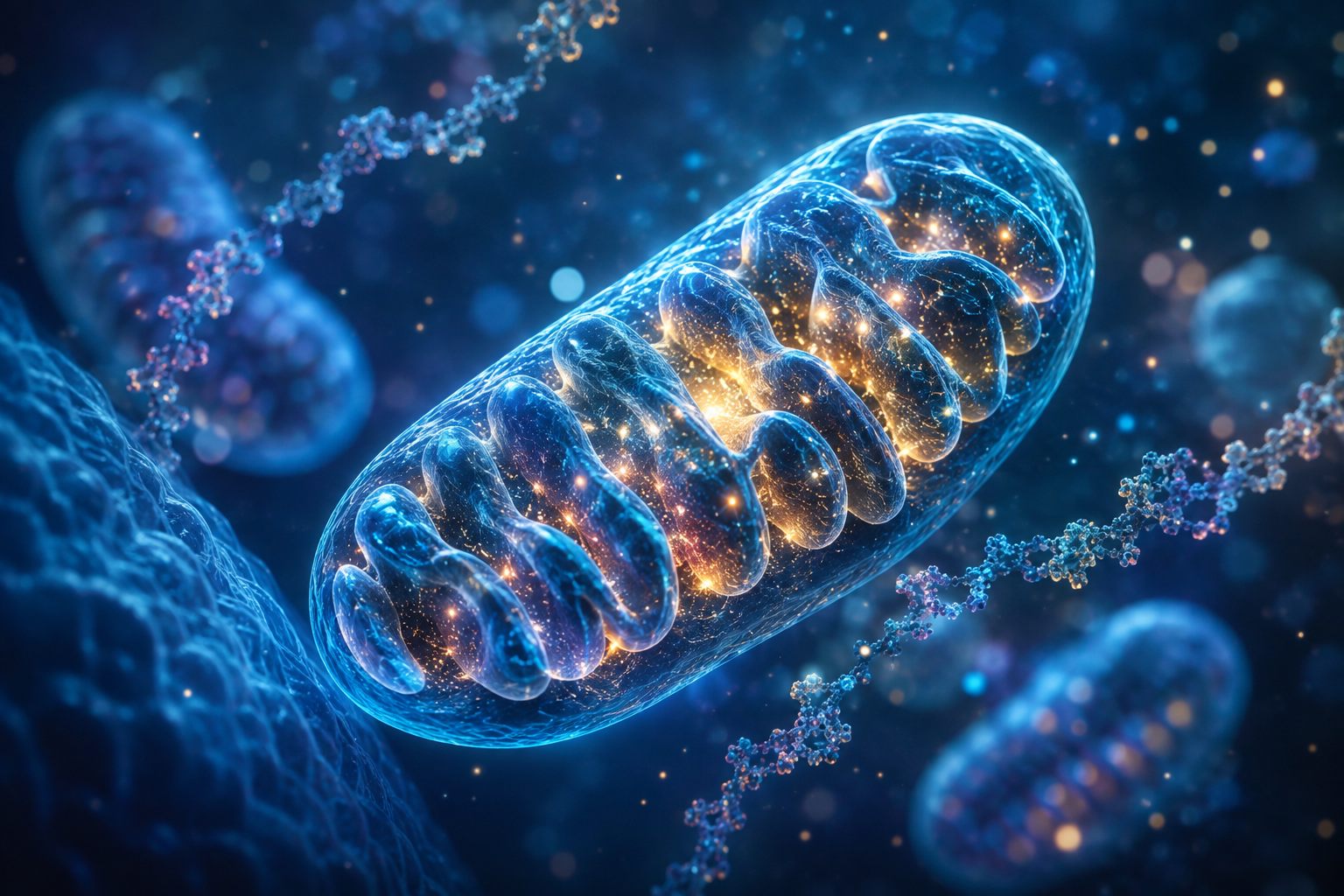
The mitochondrial peptide connecting exercise, metabolism, cellular stress and healthy ageing
We usually think of mitochondria as tiny power stations.
They sit inside our cells, take energy from nutrients and help convert it into ATP — the usable energy currency of the cell.
But that description is increasingly incomplete.
Scientists now understand that mitochondria don't simply produce energy.
They communicate.
They sense changes in the cellular environment and send signals that can influence metabolism, stress responses and even gene activity elsewhere in the cell.
And remarkably, mitochondria can produce their own signalling molecules.
One of the most intriguing discovered so far is:
MOTS-c.
MOTS-c is a small, naturally occurring peptide consisting of just 16 amino acids.
Unlike most peptides encoded by DNA in the cell nucleus, MOTS-c originates from a small open reading frame within mitochondrial DNA.
That alone makes it unusual.
But what has really attracted researchers' attention is what MOTS-c appears to do.
Preclinical research has connected it with glucose metabolism, insulin sensitivity, AMPK signalling, metabolic stress, skeletal muscle and physical performance.
And perhaps most intriguingly:
exercise itself appears to increase MOTS-c in humans.
So what exactly have our mitochondria been trying to tell us?
First: What Is MOTS-c?
MOTS-c stands for:
Mitochondrial Open Reading Frame of the 12S rRNA type-c.
Not exactly a name designed for Instagram.
It belongs to a relatively recently recognised group of molecules known as mitochondrial-derived peptides, or MDPs.
Historically, mitochondrial DNA was thought to encode only a very small collection of proteins required predominantly for mitochondrial energy production.
Researchers subsequently discovered small previously unrecognised regions of mitochondrial DNA capable of producing biologically active peptides.
MOTS-c is one of them.
It was first described in 2015 and has subsequently been detected in multiple tissues, including skeletal muscle, as well as in the circulation.
Because it appears capable of communicating metabolic information beyond the mitochondrion itself, researchers have described MOTS-c as something resembling a “mitokine” — essentially, a mitochondrial signalling molecule.
And that's where the story becomes fascinating.
Mitochondria Don't Just Make Energy — They Sense It
Every cell has to continuously answer a fundamental question:
Do I have enough energy available for what I'm being asked to do?
When cellular energy becomes limited, the body has systems capable of detecting that change.
One of the most important is an enzyme called:
AMPK — AMP-activated protein kinase.
AMPK acts as a cellular energy sensor.
When cellular energy availability falls, AMPK helps shift metabolism away from some energy-consuming processes and towards pathways that help generate and conserve energy.
This can influence:
glucose uptake fatty-acid metabolism mitochondrial activity cellular stress responses metabolic adaptation.
MOTS-c has repeatedly been linked with AMPK signalling in experimental research.
That's one major reason it has attracted attention in metabolic science.
But calling MOTS-c an “AMPK activator” still doesn't capture the whole story.
MOTS-c Can Communicate With the Nucleus
This may be the most extraordinary part.
Your mitochondria have their own DNA.
Your cell nucleus contains most of the rest.
For many years, cellular biology was often described as though instructions largely travelled in one direction:
nucleus → mitochondria.
But communication goes both ways.
Under metabolic stress, research has demonstrated that MOTS-c can move into the cell nucleus.
Once there, it can interact with nuclear gene regulation and influence genes involved in stress responses and metabolism.
In other words:
a peptide encoded by mitochondrial DNA can travel to the nucleus and influence how nuclear genes respond to metabolic stress.
Research into MOTS-c therefore forms part of a much bigger emerging field examining communication between our mitochondrial and nuclear genomes.
Your mitochondria aren't simply batteries.
They're part of the cellular communication network.
Then Researchers Discovered Something Else: Exercise Increases MOTS-c
This is where MOTS-c became particularly interesting.
Researchers examined skeletal muscle and circulating MOTS-c in healthy young men following exercise.
After exercise, MOTS-c levels increased in skeletal muscle and circulation.
The researchers concluded that MOTS-c is an exercise-induced mitochondrial signal.
That's important.
It tells us that MOTS-c isn't simply an experimental molecule scientists discovered in a laboratory.
Our own bodies naturally alter MOTS-c in response to physical activity.
And that raises an obvious question:
Why?
Exercise Is a Metabolic Stress
We tend to think of stress as something negative.
Biologically, that's not always true.
Exercise temporarily disrupts normal cellular conditions.
Muscles require more ATP.
Stored fuels are mobilised.
Oxygen demand increases.
Cellular energy balance changes.
Reactive oxygen species temporarily increase.
Muscle fibres experience mechanical and metabolic stress.
The body responds by adapting.
And those adaptations are precisely why exercise makes us fitter.
Mitochondria become better equipped to handle metabolic demand.
Muscle becomes more efficient.
Glucose regulation can improve.
Physical capacity increases.
This concept — where a manageable biological stress stimulates an adaptive response — is sometimes described as hormesis.
MOTS-c appears to participate in some of the cellular signalling associated with this metabolic adaptation.
That has inevitably led to MOTS-c sometimes being described online as an:
“exercise mimetic.”
But that description needs considerable caution.
Is MOTS-c Really “Exercise in a Peptide”?
No.
At least, we don't have evidence to say that.
Exercise affects an enormous number of systems simultaneously:
the cardiovascular system,
skeletal muscle,
bone,
brain,
blood vessels,
mitochondria,
insulin signalling,
inflammation,
mechanical loading,
and numerous hormonal pathways.
MOTS-c may participate in some metabolic pathways that exercise also influences.
That's completely different from reproducing exercise itself.
However, animal research has produced some genuinely fascinating results involving physical performance.
MOTS-c & Physical Performance
A major study published in Nature Communications investigated MOTS-c in young, middle-aged and old mice.
Researchers found that MOTS-c treatment significantly improved physical performance across age groups.
In older mice, treatment improved treadmill performance.
Researchers then began intermittent MOTS-c treatment very late in life — at approximately 24 months of age.
Later-life physical testing found improvements in measures including:
grip strength
stride length
and
walking performance.
The authors concluded that late-life MOTS-c treatment improved physical capacity and healthspan in mice.
That's an extremely interesting finding.
But three words matter enormously:
in mice.
It does not demonstrate that MOTS-c improves strength, endurance or healthy lifespan in humans.
MOTS-c & Ageing
The ageing connection goes further.
Mitochondrial function changes as we age.
So do:
metabolic flexibility,
insulin sensitivity,
muscle mass,
physical capacity,
cellular stress responses,
and mitochondrial signalling.
Researchers have reported age-associated differences in endogenous MOTS-c levels in certain tissues and circulation.
This led scientists to ask whether MOTS-c might be involved in some of the body's ability to maintain metabolic homeostasis with age.
In the same Nature Communications study, researchers found that MOTS-c influenced nuclear genes involved in metabolism and proteostasis and helped muscle cells adapt to metabolic stress.
Again, this doesn't mean:
MOTS-c reverses ageing.
It means a mitochondrial signalling peptide appears to participate in biological processes that themselves change during ageing.
That's a much more interesting scientific proposition.
Insulin Sensitivity: One of the Biggest Areas of MOTS-c Research
Another major research area is glucose metabolism.
Insulin acts as a signal telling cells that glucose is available.
When tissues become less responsive to that signal — insulin resistance — the body often compensates by producing more insulin.
Insulin resistance is strongly associated with metabolic conditions including type 2 diabetes.
Preclinical research has found that MOTS-c can influence glucose utilisation and insulin sensitivity.
Earlier mouse studies reported that MOTS-c could prevent diet-induced insulin resistance and reverse age-associated insulin resistance.
Human observational studies have also identified relationships between circulating MOTS-c and metabolic physiology.
For example, researchers studying women with PCOS and healthy controls found that circulating MOTS-c responded to experimental changes in lipids and insulin. An eight-week exercise intervention was also incorporated into the study, adding further evidence that MOTS-c participates in metabolic responses rather than behaving as a static biomarker.
But observational relationships still don't prove that giving MOTS-c improves insulin sensitivity in humans.
Until now, that question has remained largely unanswered.
And Now MOTS-c Is Entering Human Clinical Testing
This is perhaps the most important current development.
A Phase 2a randomised clinical trial, registered as MOTS-MET, is evaluating MOTS-c in adults with prediabetes and overweight or obesity.
The study is designed to test whether 12 weeks of investigational MOTS-c treatment improves insulin sensitivity compared with placebo.
Participants also receive standardised lifestyle counselling, with safety follow-up continuing after treatment.
This is exactly the kind of trial the MOTS-c field needs.
Because until controlled human trials are completed, we cannot reliably translate impressive metabolic results in mice into treatment claims for people.
So right now the science sits at an interesting point:
The biological rationale is compelling.
The animal evidence is substantial enough to justify human investigation.
But the human therapeutic evidence is not yet established.
What About Fat Loss?
This is another area where online claims get ahead of the science.
Because MOTS-c influences AMPK, glucose metabolism and energy regulation — and because animal experiments have investigated obesity and insulin resistance — it is often marketed as a fat-burning peptide.
That description isn't justified by current human evidence.
Fat loss in humans is governed by a complex interaction between:
energy intake,
energy expenditure,
appetite,
activity,
hormonal signalling,
adipose biology,
sleep,
and metabolic health.
We do not currently have robust clinical trials demonstrating that administering MOTS-c causes meaningful fat loss in humans.
The current human trial is focused specifically on insulin sensitivity, not proving that MOTS-c is a weight-loss treatment.
So:
MOTS-c is interesting to obesity researchers.
That does not yet make it an obesity therapy.
MOTS-c Is Very Different From GLP-1 Research
This distinction is also useful.
The incretin medicines we've discussed elsewhere in the Better Body Lab Research Library — including tirzepatide and investigational retatrutide — interact with receptors involved in appetite, glucose regulation and energy metabolism.
MOTS-c comes at metabolic biology from somewhere completely different.
It originates from mitochondrial signalling.
Rather than primarily targeting appetite, the research centres around how cells:
sense energy
respond to metabolic stress
use glucose
adapt to exercise
and
communicate between mitochondria and the nucleus.
That makes MOTS-c an interesting reminder that metabolic health isn't simply about how much we eat.
It's also about what our cells do with the energy they receive.
MOTS-c & NAD+: Two Sides of Mitochondrial Biology
This also connects beautifully with NAD+.
NAD+ participates directly in cellular energy metabolism, redox reactions, DNA repair and numerous enzyme systems.
MOTS-c appears to function more like a signal generated from mitochondrial biology.
One helps form part of the biochemical machinery.
The other may help communicate information about the cellular metabolic environment.
They're not interchangeable.
But together they demonstrate how sophisticated mitochondria really are.
The mitochondrion isn't merely:
food → ATP.
It's simultaneously involved in sensing, signalling, adapting and communicating.
What We Know — and What We Don't
At this point, the evidence supports several genuinely interesting conclusions.
We know that MOTS-c is a naturally occurring mitochondrial-derived peptide.
We know that it is encoded within mitochondrial DNA.
We know that it can participate in signalling involving metabolic stress and AMPK.
We have evidence that it can influence communication between mitochondria and nuclear gene expression.
And importantly, we have human evidence showing that exercise increases endogenous MOTS-c in skeletal muscle and circulation.
Animal research has demonstrated effects involving insulin sensitivity, metabolic health and physical performance.
But we do not yet know whether administering MOTS-c to humans:
meaningfully improves insulin sensitivity,
increases endurance,
reduces body fat,
improves mitochondrial function,
prevents age-related physical decline,
or extends healthspan.
Those questions require human clinical trials.
And at least one of those questions — insulin sensitivity — is now being formally tested.
Perhaps the Most Powerful MOTS-c Intervention Is Already Available
There is a wonderful irony in MOTS-c research.
People are interested in MOTS-c because of its possible relationship with:
metabolic health,
mitochondrial function,
physical performance,
insulin sensitivity,
and healthy ageing.
Yet we already have an intervention proven to improve many of those things.
Exercise.
And exercise appears to stimulate our own MOTS-c biology.
That doesn't make MOTS-c research pointless.
Quite the opposite.
It helps scientists understand why exercise is so powerful.
Every workout isn't simply burning calories.
It creates biological signals.
Muscles communicate.
Hormones change.
Mitochondria respond.
Genes alter their activity.
Cells adapt.
And MOTS-c may be one small piece of that extraordinary communication network.
The Bigger Picture: Your Mitochondria Are Talking
For decades, mitochondria were presented as simple cellular power stations.
We're discovering something much more sophisticated.
They don't merely produce energy.
They sense the cellular environment.
They respond to stress.
They communicate with the nucleus.
And they can produce signalling peptides of their own.
MOTS-c represents one of the most intriguing examples discovered so far.
Its relationship with exercise, metabolism and ageing makes it an exciting research target.
But it also illustrates something we've seen repeatedly throughout longevity science:
an exciting mechanism is not the same as a proven therapy.
The mouse data are fascinating.
The human exercise data tell us MOTS-c is genuinely part of our physiology.
And now controlled human clinical research is beginning to ask whether manipulating that pathway can produce meaningful metabolic benefits.
Until we have those answers, MOTS-c is best understood not as an “exercise peptide” or a shortcut to fat loss —
but as something potentially much more interesting:
a message written by our mitochondrial DNA that helps the cell respond to metabolic demand.
Research. Understand. Explore.
Research & Further Reading
A major Nature Communications study published in 2021 demonstrated that exercise increases endogenous MOTS-c in human skeletal muscle and circulation. The same research found that MOTS-c influenced skeletal-muscle metabolism, metabolic-stress responses and physical performance in mouse models, including older animals.
Human metabolic research has also investigated circulating MOTS-c responses to lipids, insulin and exercise, including work involving women with PCOS and healthy controls.
Most importantly for where the science goes next, a Phase 2a placebo-controlled study is now registered to investigate whether 12 weeks of MOTS-c can improve insulin sensitivity in adults with prediabetes and overweight or obesity.
Important Research Disclaimer
This article is provided for research and educational purposes only. It discusses published scientific research into MOTS-c, mitochondrial signalling, exercise physiology, metabolism and ageing.
MOTS-c is investigational and is not an approved treatment for weight loss, insulin resistance, improved athletic performance, anti-ageing or longevity. Much of the evidence discussed comes from laboratory and animal research, and findings from these models cannot be assumed to produce the same outcomes in humans.
Human clinical research is still developing, and claims regarding fat loss, endurance, energy, mitochondrial enhancement or anti-ageing effects should not be regarded as established clinical benefits.
Nothing in this article constitutes medical advice, diagnosis or a recommendation to use MOTS-c or any other peptide.
Better Body Lab | Research. Understand. Explore.