EPITALON: The science of cellular ageing
6 Jun 2026
What can four amino acids tell us about telomeres, circadian biology and longevity?
Ageing is something we see on the outside, but its origins reach deep inside our cells.
Over time, DNA accumulates damage, cellular repair mechanisms change, mitochondrial function can decline, circadian rhythms become less robust and the protective structures at the ends of our chromosomes — telomeres — tend to become shorter.
This complex biology has created an enormous field of longevity research.
And within that research is an intriguing molecule made from just four amino acids:
Epitalon.
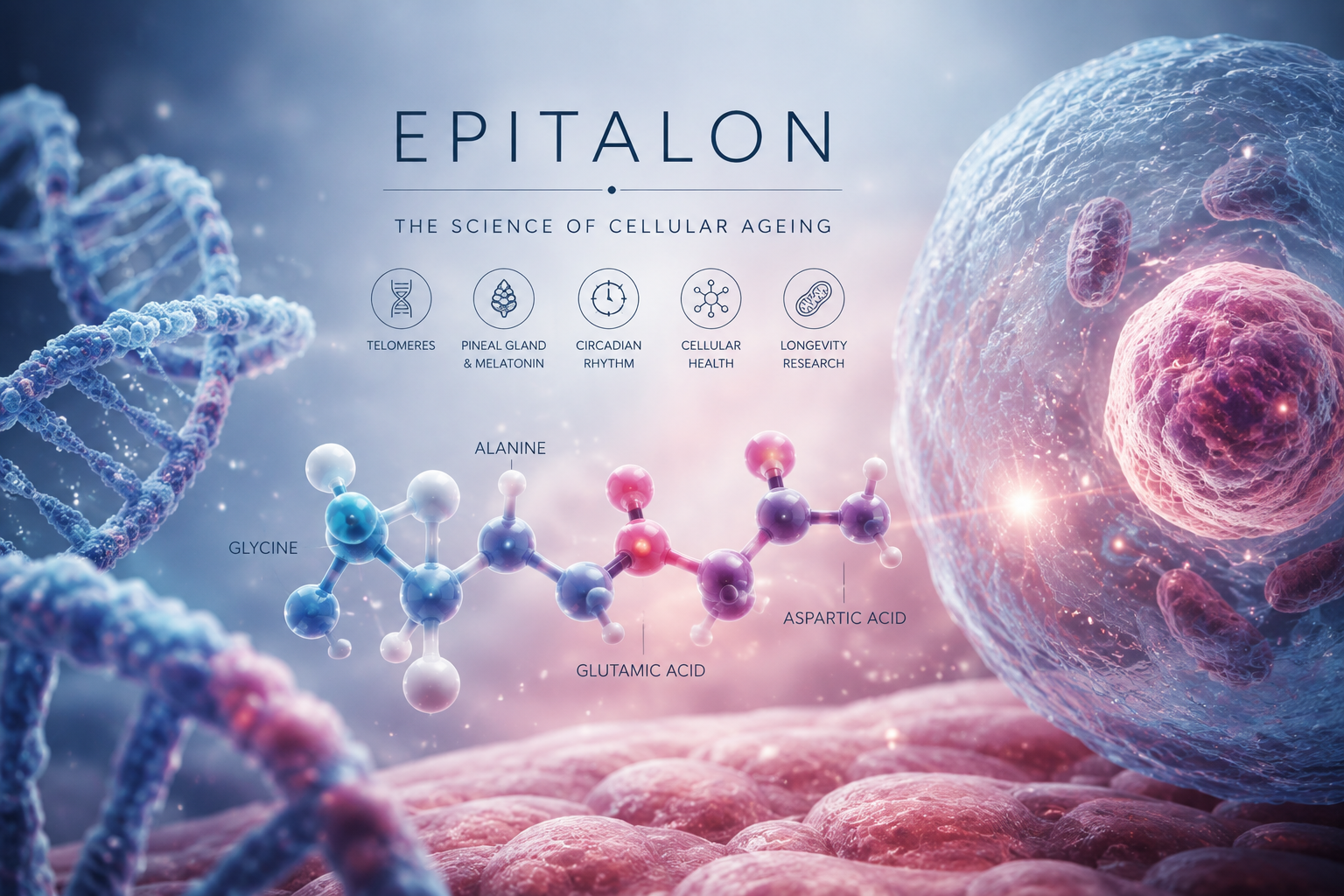
Epitalon — also known as Epithalon or AEDG — is a synthetic tetrapeptide consisting of alanine, glutamic acid, aspartic acid and glycine (Ala-Glu-Asp-Gly). It was developed following research into peptide compounds associated with the pineal gland.
Despite its remarkably simple structure, Epitalon has been investigated in several areas relevant to ageing biology, including telomerase activity, telomere length, melatonin production, oxidative stress, chromosome stability and longevity.
But the science requires some careful interpretation.
Much of the evidence remains preclinical, and promising effects observed in cells or animals cannot automatically be translated into anti-ageing effects in humans. A 2025 scientific review similarly concluded that although Epitalon has been studied for decades, its precise mechanisms remain incompletely understood.
So what have researchers actually discovered?
Telomeres: The Protective Ends of Our Chromosomes
To understand why Epitalon has attracted attention in longevity science, we first need to understand telomeres.
Telomeres are repeating DNA sequences located at the ends of chromosomes.
One of their functions is to help protect chromosomes from deterioration and inappropriate fusion with neighbouring chromosomes.
You can loosely think of them like the protective tips on the ends of shoelaces — except these particular protective structures sit at the ends of our genetic material.
In many normal human cells, telomeres progressively shorten during repeated cell division.
When they become critically dysfunctional, cells may enter senescence or stop dividing.
For that reason, telomere attrition is recognised as one feature of biological ageing.
But there is an important nuance: telomere length is not a simple biological countdown clock, and ageing cannot be reduced to the length of a person's telomeres. Telomerase and telomere structure are dynamically regulated, and telomere biology is considerably more complicated than “longer equals younger”.
Telomerase: Maintaining the Telomere
The body also has an enzyme capable of adding DNA sequences back onto telomeres.
It's called telomerase.
Telomerase is active in certain cell populations but is relatively restricted in many mature somatic cells.
And this is where Epitalon research becomes particularly interesting.
The original Epitalon experiment
In 2003, researchers added Epitalon to cultures of human fetal fibroblasts that were described as telomerase-negative.
They reported expression of the catalytic component of telomerase, increased telomerase enzyme activity and telomere elongation following exposure to Epitalon.
That finding became one of the foundations for subsequent interest in Epitalon as a longevity research peptide.
But it was an in-vitro cell experiment — not evidence that administering Epitalon lengthens telomeres or extends lifespan in humans.
And more than two decades later, researchers have revisited the question.
Newer Research: Epitalon and Telomeres in Human Cell Lines
A study published in Biogerontology in 2025 investigated Epitalon's effects on telomere biology in several human cell lines.
Researchers examined normal epithelial cells and fibroblasts as well as breast cancer cell lines.
In the normal cells, Epitalon treatment was associated with:
↑ hTERT gene expression
↑ telomerase activity
↑ telomere length
The researchers therefore produced quantitative evidence broadly supporting the earlier findings that Epitalon can influence telomerase and telomere length under laboratory conditions.
Interestingly, telomere length also increased in the cancer cell lines studied, apparently through a different process known as alternative lengthening of telomeres (ALT) rather than the same telomerase mechanism observed in normal cells.
That finding is another reason why telomere manipulation shouldn't simply be described as an anti-ageing benefit.
Telomere biology intersects with cancer biology, and the implications of manipulating these pathways in a living human are considerably more complicated than results obtained from cells growing in a laboratory dish.
The authors themselves highlighted a major limitation: this was an in-vitro study using 2D human cell cultures, and further research in more physiologically relevant models is required.
The Pineal Gland, Melatonin & Our Biological Clock
Epitalon research isn't limited to telomeres.
Another major area of investigation involves the pineal gland.
The pineal gland is a small endocrine structure in the brain perhaps best known for producing melatonin.
Melatonin helps synchronise our circadian rhythm — the approximately 24-hour biological cycle influencing:
sleep and wakefulness hormone secretion body temperature metabolism immune activity numerous cellular processes.
Melatonin secretion and circadian organisation can change with age.
Research into Epitalon and related pineal peptides has investigated whether they can influence pineal function and melatonin synthesis.
A recent comprehensive review concluded that experimental evidence indicates Epitalon can directly influence melatonin synthesis, while research has also investigated its interaction with circadian and neuroendocrine processes. However, its precise mechanisms of action remain unresolved.
This is particularly interesting from a longevity perspective because circadian health is not simply about getting enough sleep.
Our biological clocks help coordinate processes throughout the body.
The question researchers are exploring is therefore much broader:
Could influencing pineal signalling affect some of the biological processes that change as we age?
At present, that remains a research question rather than an established therapy.
Oxidative Stress & Cellular Ageing
Another recurring theme in Epitalon research is oxidative stress.
Our cells continuously produce reactive oxygen species (ROS) as part of normal metabolism.
The body possesses antioxidant systems to manage them, but when the balance shifts excessively towards oxidative activity, cellular components including proteins, lipids and DNA can be damaged.
This has made oxidative stress another important area of ageing research.
Epitalon has demonstrated antioxidant-related effects in preclinical experiments.
For example, an in-vitro study examining ageing mouse oocytes found that Epitalon reduced intracellular reactive oxygen species and was associated with improvements in mitochondrial membrane potential and several other markers of cellular quality.
Again, that's an intriguing biological result.
But mouse oocytes maintained in a laboratory are very different from an ageing human body.
It tells researchers something about possible mechanisms worth investigating — not that Epitalon has been proven to reverse oxidative ageing in people.
Chromosomes & Cellular Stability
Researchers have also investigated whether Epitalon influences age-associated changes within chromosomes.
A 2003 study examined cultured lymphocytes from people aged 76–80.
Researchers reported changes in chromatin following exposure to Epitalon, including activation of ribosomal genes and alterations involving heterochromatin — densely packed regions of chromosomes associated with regulation of gene accessibility.
Animal research has produced additional observations.
And one particular mouse experiment is frequently quoted in discussions about Epitalon and longevity.
Did Epitalon Really Extend Lifespan?
This claim needs some context.
A 2003 study followed female mice throughout their natural lives.
Researchers gave one group Epitalon and compared them with saline-treated controls.
The headline finding often repeated online is:
Epitalon increased lifespan by 13.3%.
That's true — but it isn't the complete result.
The study actually found that Epitalon did not significantly increase mean lifespan.
Instead, researchers reported that lifespan among the last 10% of surviving animals increased by 13.3%, while maximum lifespan increased by 12.3%.
They also observed a 17.1% reduction in chromosome aberrations in bone-marrow cells and changes in age-related reproductive function.
That's much more scientifically accurate than simply saying:
“Epitalon makes you live 13.3% longer.”
It doesn't demonstrate that.
It tells us that under the conditions of this particular animal experiment, Epitalon affected certain measures associated with ageing and survival.
And, importantly:
Mice aren't humans.
So, Does Epitalon Slow Human Ageing?
This is where we separate interesting science from marketing.
At present, there is not sufficient high-quality human clinical evidence to conclude that Epitalon slows ageing, extends human lifespan or produces clinically meaningful telomere elongation in people.
What we can say is that Epitalon has produced some genuinely interesting findings across several areas of experimental biology.
Research has explored associations with:
Telomerase activation Laboratory studies have demonstrated increased telomerase activity in certain human cell cultures.
Telomere elongation Telomere length increases have been observed in treated human cell lines under experimental conditions.
Pineal and circadian biology Research has investigated effects involving melatonin synthesis and neuroendocrine signalling.
Oxidative stress Preclinical experiments have reported antioxidant-related effects and alterations in reactive oxygen species.
Chromosome biology Experimental studies have reported effects involving chromatin and chromosome aberrations.
Animal longevity Some animal experiments have produced changes in maximum or late-life survival, although effects on average lifespan have not been consistently demonstrated.
These are research findings, not established therapeutic outcomes.
Why Epitalon Is Still Interesting
Perhaps the most interesting thing about Epitalon isn't whether it ultimately becomes an anti-ageing therapy.
It's what studying it can teach us about ageing itself.
A molecule consisting of only four amino acids has led researchers into questions involving telomeres, gene expression, circadian rhythms, oxidative stress and cellular longevity.
And those areas increasingly appear interconnected.
Ageing isn't one process.
It's an accumulation of changes occurring across multiple biological systems.
That is also why claims that any single compound can simply “reverse ageing” deserve considerable scepticism.
The science of longevity is much more complicated — and much more interesting — than that.
Epitalon remains an intriguing experimental peptide precisely because there are still so many unanswered questions.
Research. Understand. Explore.
Research & Further Reading
Epitalon & Telomerase — 2003 Khavinson VK, Bondarev IE & Butyugov AA. Epithalon peptide induces telomerase activity and telomere elongation in human somatic cells. Bulletin of Experimental Biology and Medicine.
Epitalon & Telomere Length — 2025 Al-Dulaimi S et al. Epitalon increases telomere length in human cell lines through telomerase upregulation or ALT activity. Biogerontology.
Epitalon & Mouse Longevity — 2003 Anisimov VN et al. Effect of Epitalon on biomarkers of aging, life span and spontaneous tumor incidence in female Swiss-derived SHR mice. Biogerontology.
Epitalon Scientific Review — 2025 Araj SK et al. Overview of Epitalon—Highly Bioactive Pineal Tetrapeptide with Promising Properties. International Journal of Molecular Sciences.
Epitalon & Chromatin — 2003 Khavinson VK et al. Peptide Epitalon activates chromatin at the old age. Neuro Endocrinology Letters.
Important Research Disclaimer
This article is provided for research and educational purposes only. It discusses published scientific research into Epitalon, cellular ageing, telomeres and longevity biology.
Epitalon is an experimental peptide and the findings discussed here should not be interpreted as evidence that it prevents, treats or reverses ageing or any disease in humans.
Much of the evidence discussed comes from laboratory and animal research. Results obtained in cells or animals cannot be assumed to produce the same effects in humans.
Nothing in this article constitutes medical advice or a recommendation to use Epitalon or any other peptide.
Better Body Lab | Research. Understand. Explore.